

Short films were first officially recognized at the Oscars in 1932 when the 5th Academy Awards introduced two categories honoring live-action “short subject” motion pictures and one honoring cartoons. The Academy would take almost a decade to add a category specifically devoted to documentary shorts, but nonfiction films were represented in this area of the Oscars from the start. In fact, all three of the nominees for Best Live Action Short Subject (Novelty) were documentaries, and one of them was named the winner at the ceremony that November.
In all, seven documentary shorts won Oscars during that time before they received their own category. Following the first documentary to win an Oscar, these shorts proved the need for exclusive awards for nonfiction cinema. While the Academy didn’t honor a documentary at every one of their first 13 ceremonies, they at least nominated nonfiction films for Oscars every year of their awards during that period. Most were shorts recognized in the Novelty category, which was intended, in part, for newsreels, travelogues, and other types of nonfiction works.
What constitutes a documentary is up for discussion, but I’m only considering films that don’t consist solely of scripted reenactments of events performed by professional actors. Give Me Liberty, which won the Oscar for Best Short Subject (Color) in 1937, is technically listed as a documentary on IMDb, but it’s a wholly dramatized, narration-free account of Patrick Henry’s famous “Give me liberty, or give me death” speech in 1775. Similar winners in later years, such as Declaration of Independence, Sons of Liberty, and Teddy the Rough Rider, lack this label, and none of them qualify for this focus.
Excluding those history films, here’s a breakdown of the first seven short documentaries to win Oscars:
Wrestling Swordfish (1931)
Mack Sennett’s eight-minute documentary Wrestling Swordfish officially won the inaugural Oscar certificate for Best Live Action Short Subject (Novelty), though some historians might add an asterisk to its victory. According to the November 8, 1932, edition of Variety, this now-lost record of one of Sennett’s own deep-sea fishing trips originally came in second place during the nominating committee’s vote. The Pete Smith production Swing High, which showcases the trapeze artist family The Flying Codonas, received 133 points, while Wrestling Swordfish earned 128 points. Yet, the 15-person committee reportedly picked the latter as the winner, causing some confusion.
To settle the “mix-up,” the Academy reportedly was to hold a run-off for the new category, with voting opened up to all members following a screening of the two documentary shorts on November 9. According to the following week’s edition of Variety, however, the decision was still being determined by the nominating committee at a meeting held on November 14, with a revote needed because some of its members weren’t present at the final voting. Wrestling Swordfish was again deemed the winner, as acknowledged at the ceremony on November 18 and in the November 22 edition of Variety, but the trade gave no further details on the process.
Some accounts claim that Sennett bullied for the result. IMDb’s trivia notes for both films paint him as a villain in the matter. This also probably could have just ended with a compromise of a tie (after all, Fredric March and Wallace Beery tied for the Oscar for Best Actor that same year due to a rule involving any tally where the outcome has two top choices separated by three or fewer votes). In his 1993 book Behind the Oscar: The Secret History of the Academy Awards, Anthony Holden implies that the Academy Executive Secretary was at fault in the scenario for avoiding his responsibility to cast a tie-breaking vote. We may never know the whole truth.
We also may never know which film deserved the Oscar more. Wrestling Swordfish appears to be lost, with only its positive reviews remaining to indicate its worth. Swing High is a decent spotlight of an impressive act that might not otherwise be seen by its audience without this cinematic record. Its narration is overdone. Its slow-motion sequences are appreciated, adding an element that even those seeing The Flying Codonas live wouldn’t get. I actually might have preferred the mostly lost third nominee, Screen Souvenirs, an archival compilation that treats cinema as a kind of time machine where we can revisit people and events of the past through old film footage.
The big irony of the Wrestling Swordfish win is that Sennett was and remains best known as an icon of slapstick comedy films, yet he received his only competitive Oscar for a work of relatively serious nonfiction. The Keystone Studios founder and former Charlie Chaplin boss was only nominated for one other film. The same year that Wrestling Swordfish won, the Sennett-produced short The Loud Mouth was up for the inaugural Oscar for Best Live Action Short Film (Comedy). That lost to the Hal Roach-produced Laurel and Hardy short The Music Box. Presumably, the results in that race weren’t even close, as there was no dispute or run-off there.
Krakatoa (1933)
Another documentary that’s hard to find today, the 26-minute film Krakatoa won the second Oscar for Best Live Action Short Subject (Novelty). It’s an educational production depicting the 1883 eruption of the titular volcanic island, and its sound design was apparently as significant as its visual spectacle. I wouldn’t know, unfortunately, but reports of its impact on theatrical exhibition make it seem to have been for sound systems what James Cameron’s Avatar was for digital 3D projection. The film was originally narrated by play-by-play sports broadcasting pioneer Graham McNamee, though a 1965 re-release replaced him with actor Joseph Cotten.
City Of Wax (1934)
The nine-minute nature documentary City of Wax won the Oscar for Best Live Action Short Subject (Novelty) the next year, at the 7th Academy Awards. It’s such an emblematic educational film, with its close-up look at honey bees and its droning narration (by actor Gayne Whitman), that you can easily picture it running through a rickety high school projector. But it gets dark at the end, almost seeming to have a political message about the uniformity and disposability of workers in such a system. That probably wasn’t intended.
City of Wax was produced and directed by brothers Horace Woodard and Stacy Woodard, the latter of whom also worked on The Sea, a short documentary nominated in the same category the previous year. They made other nature documentaries together, but later they separately went into business with the U.S. government. Horace Woodard went on to shoot part of the important World War II propaganda film The Negro Soldier, and Stacy Woodard shot part of Pare Lorentz’s classic New Deal propaganda film The River.
Wings Over Everest (1934)
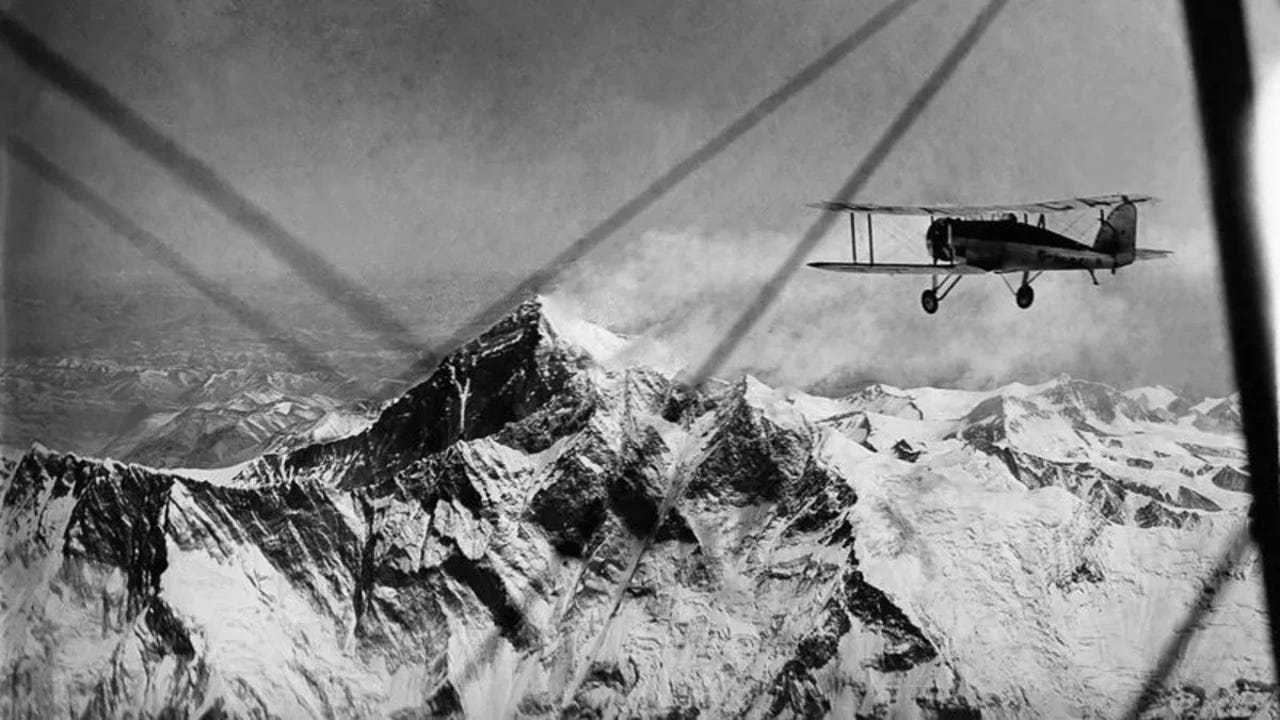
At the 8th Academy Awards, three more documentaries were nominated in the Live Action Short Subject (Novelty) category, while one of the first films we’d classify as a mockumentary, How to Sleep, was nominated and won the Oscar for Best Live Action Short Subject (Comedy). The Novelty winner was the 22-minute film Wings Over Everest, which reminded me of the first documentary Oscar winner, With Byrd at the South Pole, because it similarly presents views of a cold, rough, as-yet inaccessible place that were unavailable to audiences before film cameras could be taken up in airplanes. In this case, that location was the peaks of Mount Everest.
While the film highlights exclusive footage of a historical expedition, and it is part of that era when cinema was commonly a part of scientific exploration, not just a representation, Wings Over Everest is nowhere near an achievement on the level of With Byrd at the South Pole. Most of the film consists of the real people, including pilots Lord Clydesdale and David McIntyre and financial benefactor Lady Houston, in staged reenactments of the lead-up to the flight. And they are as lifeless as you might dread with a documentary. The footage taken from the planes is important, but also not the most exciting, plus the clearer shots are apparently from a later flight.
The Private Life Of The Gannets (1934)
The Novelty category went away after the 8th Academy Awards (as did Comedy shorts), but that didn’t stop nonfiction from being nominated. The Oscars changed its live-action shorts categories to award the best one-reel, two-reel, and color films. An installment of Paramount’s educational Popular Science series (“J-5-1”) was nominated for Best Short Subject (Color), while the music film Moscow Moods was up for Best Short Subject (One-Reel). No documentary won at the 9th Academy Awards. However, as already mentioned, the completely dramatized Short Subject (Color) winner, Give Me Liberty, is labeled as a documentary on IMDb. Also, the significant nonfiction film series The March of Time received a Special Award for revolutionizing the newsreel.
One year later, at the 10th Academy Awards, The Private Life of the Gannets won the Oscar for Best Short Subject (One-Reel). The 10-minute film is another old-fashioned educational nature documentary focused on a single animal, and even compared to the fantastically shot City of Wax, it’s pretty simple. It takes us to the island of Grassholm, off the coast of Wales, to observe the titular seabirds. The one notable thing about the film is that famed documentarian, critic, and theorist John Grierson was one of its cinematographers. And he specifically shot the short’s best footage, a slow-motion sequence of gannets diving into the ocean to catch fish.
Non-winning documentaries nominated that year include another installment of Popular Science (“J-7-1”) and the Pete Smith short Romance of Radium, a fully narrated, acted-out history of the titular element that was helmed by future horror and film noir auteur Jacques Tourneur. The former was up for Best Short Subject (Color) but lost to another Pete Smith production, Penny Wisdom, which is a comedy but also served to promote the newspaper advice columnist Prudence Penny. The latter lost to The Private Life of the Gannets, which was a more unique achievement at the time.
