

With this year’s Oscars behind us, we are already looking ahead to the 100th Academy Awards in 2028. That milestone event is two years away, which will hopefully give us plenty of time to achieve our own feat: watching and reviewing every Oscar-winning documentary. Or, at least all the ones that are available. According to IMDb, 208 documentaries have won Academy Awards in some category or another, not just in the two that have recognized nonfiction films competitively since the early 1940s. With only around 100 weeks until our deadline, we may need to double up on some. We begin with this Documentary Classics column on With Byrd at the South Pole.
The very first documentary nominee was recognized at the very first Academy Awards. Merian C. Cooper and Ernest B. Schoedsack’s 1927 ethno-tainment film Chang: A Drama of the Wilderness became one of the inaugural contenders in the Unique and Artistic Picture category, which was immediately discontinued (the category was essentially the same as the other top award, Outstanding Picture, which went through a series of name changes before taking its current designation of Best Picture in 1962 — meaning Chang was basically the first and only documentary to come close to being nominated for the Academy’s highest honor).
Two ceremonies later, and more than a decade before the mode would receive its first exclusive category, With Byrd at the South Pole became the second documentary nominated for an Oscar. Less remembered today, the 1930 feature was then recognized in the Best Cinematography category, competing against four dramas that remain well-known nearly a century later: Lewis Milestone’s All Quiet on the Western Front, Howard Hughes’s Hell’s Angels, Ernst Lubitsch’s The Love Parade, and the famous “Garbo Talks!” cinematic event, Anna Christie. At the 3rd Academy Awards held on November 5, 1930, the documentary won the Oscar, with cinematographers Joseph T. Rucker and Willard Van der Veer receiving statuettes.
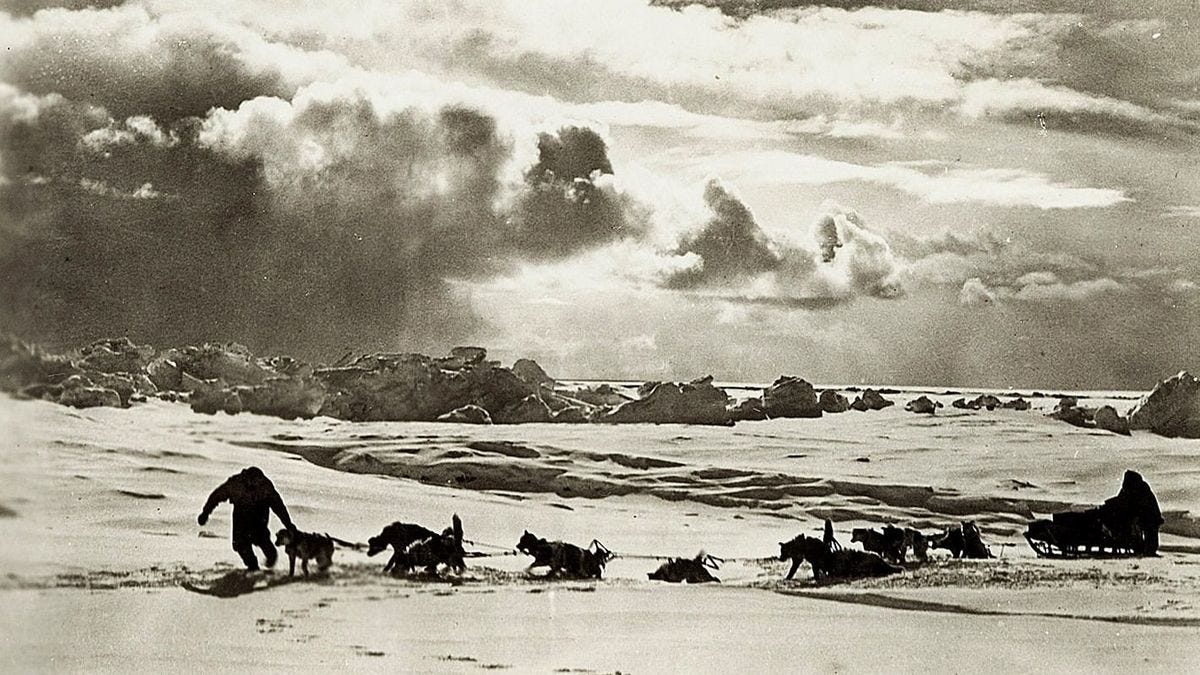
Both men shot footage for the film while accompanying Richard E. Byrd on his first Antarctic expedition from 1928 to 1930, a trip that included the first flight over the South Pole. While I can’t confirm details of the production history, the release date credited to With Byrd at the South Pole is June 19, 1930, just one day after the expedition’s return to the U.S. (perhaps the film deserved a special Oscar for editor Emanuel Cohen for such a swift job?). While Rucker and Van der Veer’s visuals are noteworthy for how they were captured, through harsh conditions across land, sea, and air, many of their shots are also quite artistic. When possible, light, shadow, and framing are given serious consideration. This isn’t just plain documentation.
The most memorable moments of aesthetic intent bookend the film. Shadows of men seem to climb the sails of Byrd’s flagship, City of New York, in the opening sequence. In the end, Byrd and his dog, Igloo, sit on the ship in silhouette, finally at rest. Right before that conclusion, the documentary shows the City of New York ascending from a fog, initially looking like a ghostly mirage. I also really like the shots from Byrd’s plane as it’s flying over Antarctica, particularly those featuring propellers in motion on the edge of the screen. The framing might not have been a creative decision so much as a practical vantage, but the result either way underscores its significance.
With Byrd at the South Pole was hardly the first documentary film of an Antarctic expedition, nor even the first to be filmed on location on the continent. One of the first known feature-length documentaries, 1919’s In the Grip of the Polar Pack Ice (since retitled South: Sir Ernest Shackleton’s Glorious Epic of the Antarctic), was made by Frank Hurley as he traveled with Shackleton’s Imperial Trans-Antarctic Expedition. Before that, short documentaries exhibited footage from expeditions led by Nobu Shirase and Douglas Mawson. Still, this feature’s mixing of cinema, airplane travel, and Antarctic exploration, all of which are peaking at this time after really coming into being around the turn of the century, is just so perfect.
As a record of events, With Byrd at the South Pole appears comprehensive. While it includes many intertitles telling the audience about the expedition, the film also shows everything. Rucker and Van der Veer captured the arrival, the building of Little America, travels by dogsled and plane, multiple blizzards, including the one that destroyed Byrd’s initial aircraft, incredible visits with penguins, whales, and seals, and plenty of scenes depicting the team’s daily work. We see a lot of manual labor tasks and little recreation. Even the scene of two men sitting down, enjoying a pipe and casual conversation, is not necessarily relaxing, as the topic of discussion is how much they miss their families, including a newborn baby not yet seen.
