

One of the scariest lines I’ve heard spoken in a movie in a long time (and I might be paraphrasing) comes early on in Yuval Abraham and Rachel Szor’s sophomore documentary feature, NAZA: “Having AI decide who lives and dies is better than the person whose friend was killed by Hamas last week.” While there’s some truth to the fact that the latter option is problematic — emotions shouldn’t vengefully drive decisions in war — the former is even worse because there’s no humanity there at all.
It was already bad enough when drones made killing so impersonal. But that’s the way it’s gone with technology for ages. From swords to muskets to sniper rifles to tanks to missiles to drones, advancements in weaponry have often further distanced the militaries from their targets, removing another level of human connection. But leaving it up to computers with their algorithmic reasoning really eliminates any concerns about emotions getting in the way, for better or worse. If you were terrified as I was with the cyber warfare presented in Alex Gibney’s Zero Days, imagine if we had today’s AI when that film was made a decade ago.
In retrospect, that statement in NAZA seems like a brief, minor comment for the film, which is Abraham and Szor’s follow-up to their Oscar-winning feature debut, No Other Land. But it lingers throughout as you’re watching, hearing from many anonymous former Israeli military personnel disclosing strategies and procedures behind the attacks on Gaza since the October 7 massacre. In addition to revelations about AI use, they divulge dystopian levels of surveillance at play (at times it made me recall Laura Poitras’s Citizenfour) and the genocidal rationale behind how many civilian casualties are permitted for every one intended mark — the film’s title comes from an acronym for a Hebrew term translating to “collateral damage” that the Israeli government uses to dehumanize its victims in Gaza even more, as abstract figures.
Some of these obscured and vocally altered documentary participants sound regretful. Others don’t seem to care what they’ve been a part of. Another admits that what they’re doing correlates to the Holocaust (giving additional dark irony to a shot of an ad for a Claude Lanzmann tribute). But it’s difficult to tell how they all feel. Unlike the violent perpetrators presented in films like Joshua Oppenheimer’s The Act of Killing and The Look of Silence, or the more hands-off defense secretaries of Errol Morris’s The Fog of War and The Unknown Known, among countless other comparisons, the interviewees in NAZA don’t show their faces, so we don’t see their expressions, whether they’re apathetic or full of remorse. We don’t even hear their true voices, though I think the tone of the speech is theirs. They’re as removed from us, as far as human connection is concerned, as their victims were from them. Maybe there’s a point there, even if the anonymity was a necessity rather than a choice, but it feels counter to the gist of the documentary overall.
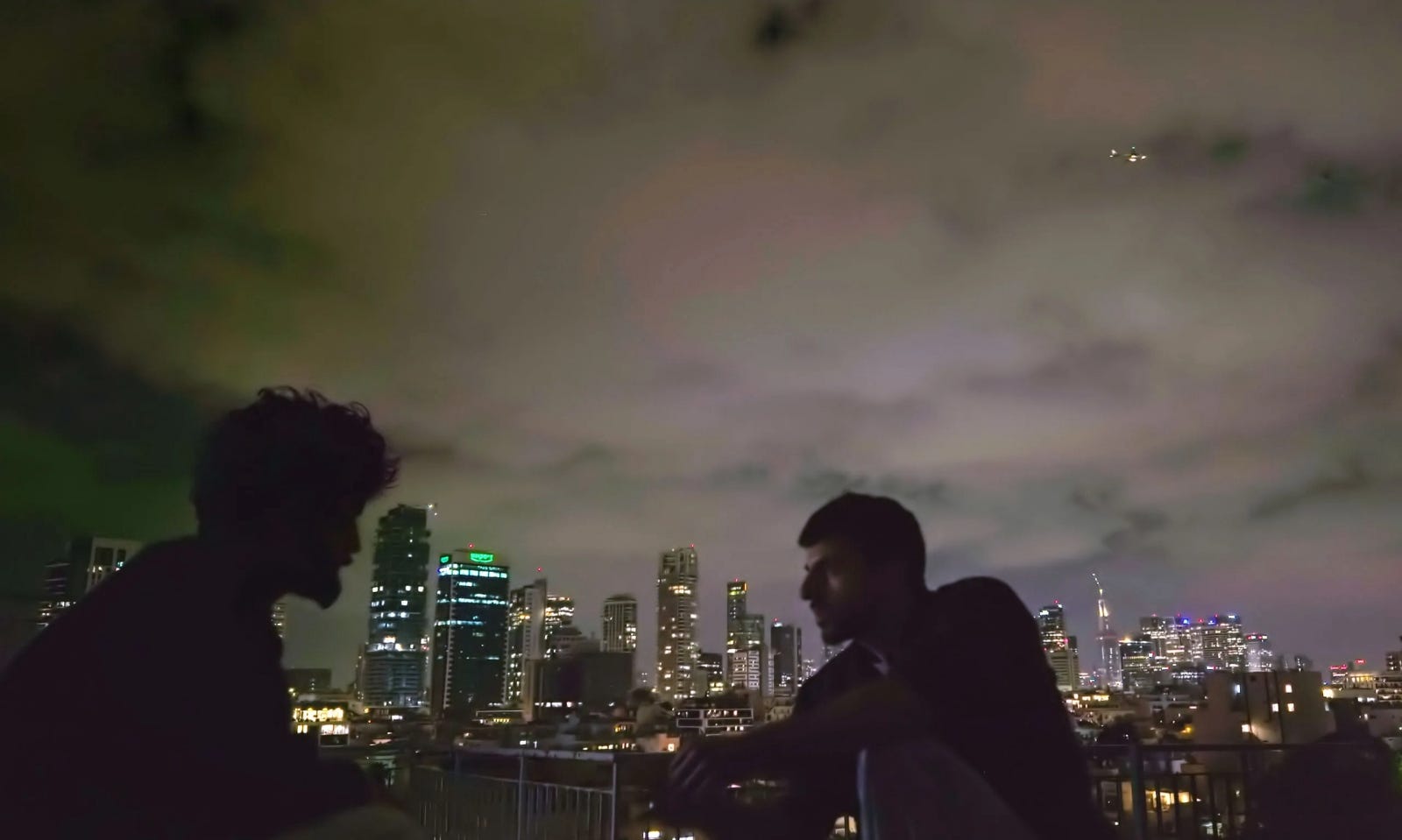
Another visual motif carries more analogical weight. Between the testimonials, which consist of Abraham on screen talking to the film’s participants in shadow one by one on rooftops at night, the documentary cuts to closer shots of the buildings in the background. Is this to make the audience think about the buildings that are discussed as targeted and flattened by Israeli strikes? We see people in the windows of these buildings, but never their faces either. Do they correlate to the faceless, innocent civilian Palestinians killed without a care for who or how old or young they were? NAZA has a consistent style that may be more circumstantial than anything. At its core, the documentary is about information, not the people providing it.
If this were a film about these documentary participants being genocide participants, it would be letting them off the hook somewhat. Abraham tells one of his interview subjects, who confesses he and others have thought they were participating in genocide, but no longer, that they already did. There’s no excusing them. But also no identifying them. It’s a film, rather, about the casualties and those in mourning for them. We are shown some of them — fathers crying, searching for children in rubble, and kids’ legs sticking out of leveled buildings. I wish we were shown even more of this horrifying imagery. It’s also a film about the way the world is going with war and AI, and that should be a terrifying gateway for viewers over here to see, or at least mainly hear, what’s already going on over there.