

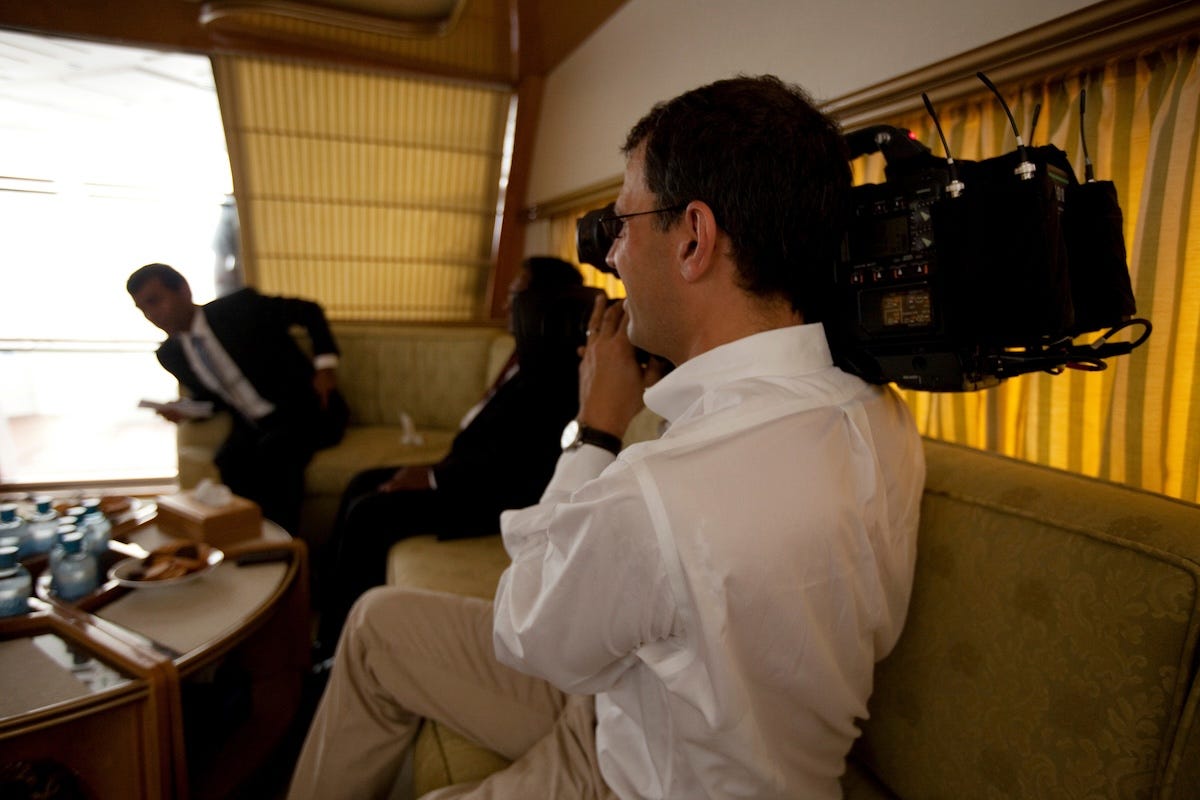
And now here’s the second part of my interview with Jon Shenk, director of the must-see documentary The Island President, which follows the former Maldivian President Mohammed Nasheed (he was just recently deposed in a coup) in a fight to save his people in more ways than one. I would call this post the second half (as I did yesterday), but it’s actually much, much longer than the first part (read that here).
In this segment, which is less directly tied to his new film, Shenk and I talk about containing documentary narratives versus (or in addition to) addressing their real-life continuation on or off screen, how The New York Times’ Op-Docs now substitute for DVD extras, what it was like being the in-house documentarian for Lucasfilm, and finally his take on where documentary filmmaking is at today.
The conversation is long, but I assure you it’s very interesting stuff.
Adding an update on Nasheed and the Maldives at the end of the film works for the story, but what is your usual view on that kind of thing? Personally, I get annoyed with Q&As where people just want to know the latest on a subject, because film narratives should be somewhat contained, even with documentary. What are your thoughts on viewers’ desire for the continued story?
I’m in your camp. I think of documentaries as films. They’re movies, and they have stories. And in the shooting and the editing, there’s a structure to that. It’s not an accident that they turn out how they turn out. Good documentary filmmakers think about it that way. Like anybody who makes a film about a current event, when things change [afterward] you’re going to be asked, “Well, do you want to change the ending? Are you bummed that you didn’t film long enough?” It’s kind of absurd. The film is what it is.
Several years and a lot of energy went into making it what it is, and hopefully that will stand the test of time. When I’m in the editing room, I think about the audience, of course, in the immediate future, but also part of my mind is thinking about the fifty- or hundred-year audience that’s going to see it much later. In that case, it won’t really matter what happened to Nasheed. All that will matter is the impact of the story that you captured.
On the other hand, I don’t blame the audiences for wanting to know. Part of the double-edged sword of a documentary, and what makes them so powerful, is that they are true. And it’s only human nature to want to know what happened to this guy or these people. I’m more than happy to talk about that and maybe even think about that as a film one day. Who knows? That’s another thing, a whole other potential story that we’re maybe just at the beginning of now.
When I was 10 years old, I saw Animal House in the theater, so it was one of my most memorable movie experiences, and at the end they have these great, very funny, pithy titles about what happened to all the characters. It doesn’t really change the movie. It’s just a funny thing to leave you with. Of course, it’s a comedy, but I’ve always loved the idea of short updates at the end that allow you to think about the issue in time.
Documentaries and films share one thing. Well, they share a lot of things, but one thing they share is very important: time is so poignant. If you take a picture of a kid and then you wait 70 years and take a picture of the adult and say simple things about their life — they went to school, they got married, they had kids, eventually they died — almost any human being will be brought to tears by simple stories like that.
I think documentaries can be special because if you add the element of time and give a sense of the trajectory, in that there’s a real story here, it can get under your skin even more. I’ve always liked that idea, to encourage people to think about time and what happens to people, how they evolve, and how characters can change over time.
So I don’t have a problem adding little updates, but in terms of the film itself, I totally agree with you. It’s like, look, a lot of energy went into this; I hope you can appreciate it. I think it’s really satisfying, and I hope you can see what I saw.
And things happen so quickly these days. The Island President only premiered last fall, and then a big turn of events happened shortly after in February. Combine the speed of developments with the fact that documentaries take a long time to be finished and then, unfortunately, often a long time to be released. By the time the DVD comes out, there seems to be a need for an update, especially if it involves current events like this does.
Unfortunately, even distributors and sales agents and people who know documentaries often get confused between a documentary film and news. In a lot of ways there are some similarities — we use the same equipment, and in some ways there’s the same visual language — but it kinda ends there. When you’re making a documentary, you’re really thinking about a story and an evolution of character. In some ways it’s like a Shakespearean character outline more than it is a news story. Not to be too highfalutin about it. You’re really in that space more than you’re in the space of thinking about current events when I’m working.
So when people say, “Hey, do you want to go shoot an addendum or change the ending?” I would not consider that. What I would consider is, maybe there could be a little short made or a clip, outside of the film, that allows people, if they’re interested, to go to a website. Or when it plays on TV, another thing. But the film is the film.
