

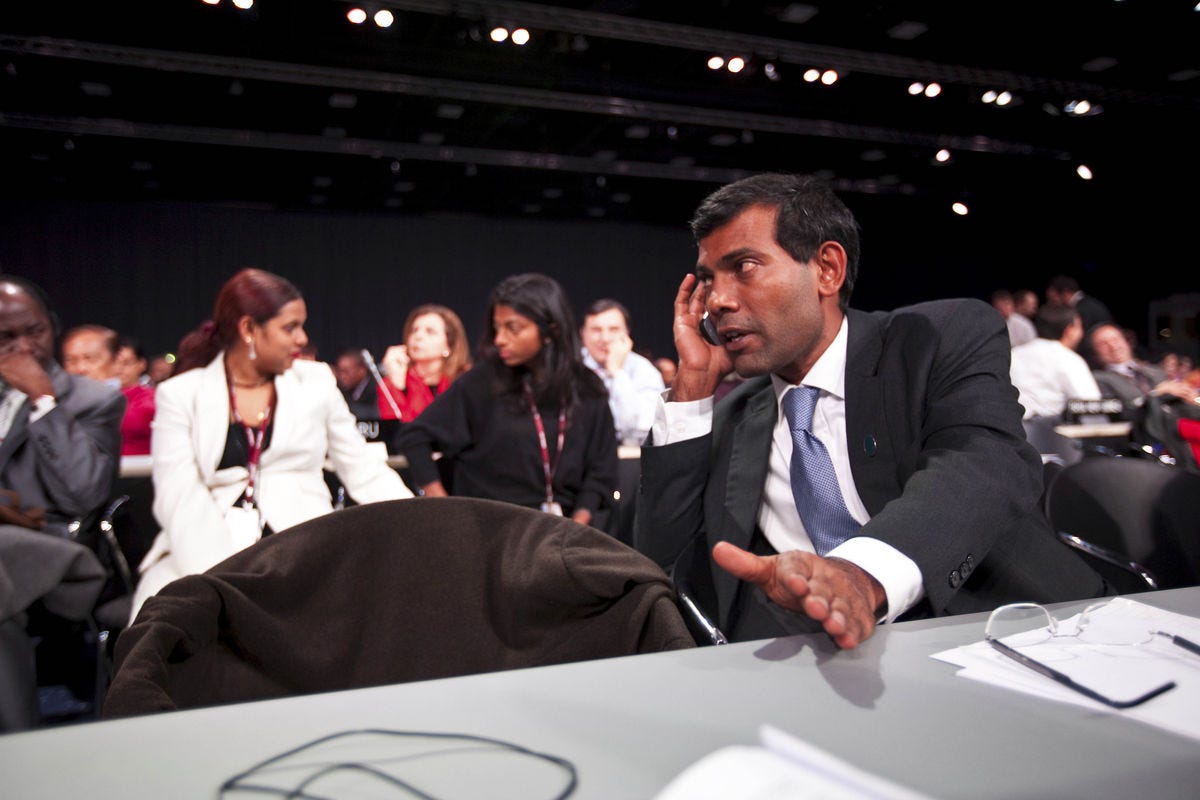
Jon Shenk’s exceptional new documentary, The Island President, is a special work of nonfiction and character-driven storytelling. It follows Mohammed Nasheed, then the president of the Maldives and the first democratically elected leader of the country in more than 30 years (he’s sadly since been deposed in a coup), as he adapts his people to freedom and embarks on a crusade to save their land by fighting to curb global warming (if the sea level rises, it will submerge the island nation). He’s the most captivating political documentary subject since Street Fight’s Cory Booker.
This week I chatted with Shenk, a filmmaker who got his start as an in-house documentarian at Lucasfilm leading up to the release of Star Wars: Episode 1 - The Phantom Menace (his early work can be found among the prequel’s DVD extras) and who has directed such major works as Lost Boys of Sudan and The Rape of Europa and contributed to others like No End in Sight and Eames: The Architect & The Painter.
Because we talked for a bit, I’ve divided the interview up into two parts. This first half of the conversation is more of an introductory discussion of what drew Shenk to Nasheed, why this is the most exciting address of climate change yet, and how the recent developments fit into the story. I hope it all will entice you to see the film. And return for part two, which involves less direct talk of this film and docs in general.
How did you first become interested in or introduced to Mohammed Nasheed?
I first heard about Nasheed when he was elected president in October ‘08. There was a little bit of coverage in the American press. I read about it in the [New York] Times. And then if you looked into it, it was covered pretty well in the UK because they have a closer tie to the Maldives. The story was instantly interesting because it was the first democratic election for president in the Maldives. And the Maldives are 100-percent Muslim, so in hindsight it seems like kind of a bellwether for what’s going on in the Middle East, but at the time it was very unusual.
Then when he stepped into office, he immediately started saying incredibly profound and honest things about the environmental situation. He did not pull punches. He said it how it was. I think he even said, half-jokingly, that the Maldives were looking for a new homeland for its people because inevitably it will be underwater. I just started following him in the news, and the more I learned, the more unique he seemed to me, and then one thing led to another.
So were you mostly drawn to him as a character, or was there also the appeal of the issues regarding democracy and climate change?
Well, the whole package was really appealing. But I have to say the thing that draws me to stories is character. Number one is you have to have a story and a character to make a film. That’s what films are. To me, anyway.
Some documentary filmmakers forget that part.
Once I heard [D. A.] Pennebaker say that he doesn’t know how to make films about things that have already happened. For me, I kinda modify that a little bit. I don’t know how to make films that don’t have people, that don’t have characters. It’s very hard for me to make “essayistic” or “argument” films or whatever you want to call them. Of course, one can do it with interviews and talking about issues. I think it’s difficult to do what cinema does best, which is to move people’s hearts and to get people to emotionally respond to things. That’s why we go to the movies. That’s why they’re magical. You want to lose yourself in a character and cry and laugh and feel the world from that perspective.
The thing that Nasheed made me realize when I started reading about him, before I even met him, is that climate change is not a boring topic. I think if you look at the movies and read the press on it, there’s almost a dead, helpless feeling about the issue, because it’s so difficult to report on it. You can easily get lost in the science and the argument about it. What Nasheed helped me do is realize, “No, wait a minute, this is the most exciting issue in the world.” We’re talking about the impending apocalypse. Then you add to that a hero who’s trying to save the world? That’s like The Bourne Identity. Of course, there’s a social issue aspect to the film, but hopefully it’s all through the eyes of the story and the character.
