'Underland' Review
From executive producer Darren Aronofsky, this documentary feature adapted from Robert Macfarlane's nonfiction bestseller offers a triptych showcasing subterranean explorers.
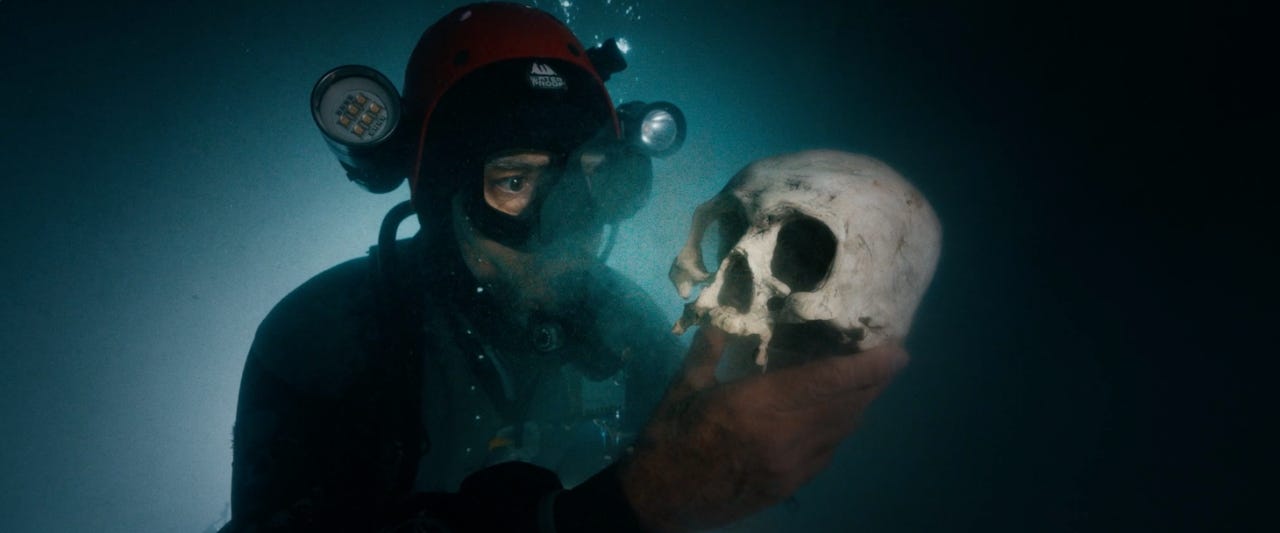
While much of the world is getting lost in the liminal spaces of Backrooms (a horror film I found disappointingly dull), I am thrilled to share a documentary interested in the seemingly limitless spaces underneath the ground’s surface and the definitely unlimited spaces of time, both backward and forward. Underland presents an intertwined triptych showcasing three subterranean explorers. One of them ventures into cenotes in Mexico to map out and reveal evidence of ancestral Mayan uses of these caves. Another is an urban explorer taking viewers through the sewers beneath Las Vegas. The third is a theoretical physicist conducting experiments more than a mile underground in pursuit of proof of the existence of dark matter.
The last of these participants, Mariangela Lisanti, might seem more stationary in her journey than the other two, but that’s where Underland distinguishes itself from being just about material space. Lisanti’s work at SNOLAB relates to the mysteries of the universe, including its origins billions of years ago. Fátima Tec Pool’s archaeological findings in the cenotes also involve contemplation of a more recent yet still ancient past. Bradley Garrett shows us near-contemporary remnants of modern history and wonders how they might become the findings of some future scientists many centuries or millennia from now. Lisanti, too, considers later generations as she gives in to the idea that what she’s seeking might not be found in her lifetime or the next.
In addition to all that Underland makes viewers think about with its themes involving space, time, myth, mystery, memory, physical relics, and theoretical “ghosts,” the film offers a magnificent visual and aural experience. Director Rob Petit, collaborating with producer Darren Aronofsky, cinematographer Ruben Woodin Dechamps, editor David G. Hill, narrator Sandra Hüller (hopefully bringing in the Project Hail Mary fans) and composer Hannah Peel, has delivered an adaptation of Robert Macfarlane’s book of the same name that left me curious about that text but certain that no words could match the sensational cinematic treatment of its subject matter in front of me. I recommend seeing the film in a very dark theater with a great sound system and constant air conditioning pumping through the auditorium. Or, at least, as I did, on a large screen in a cold, dark room with noise-canceling headphones.


