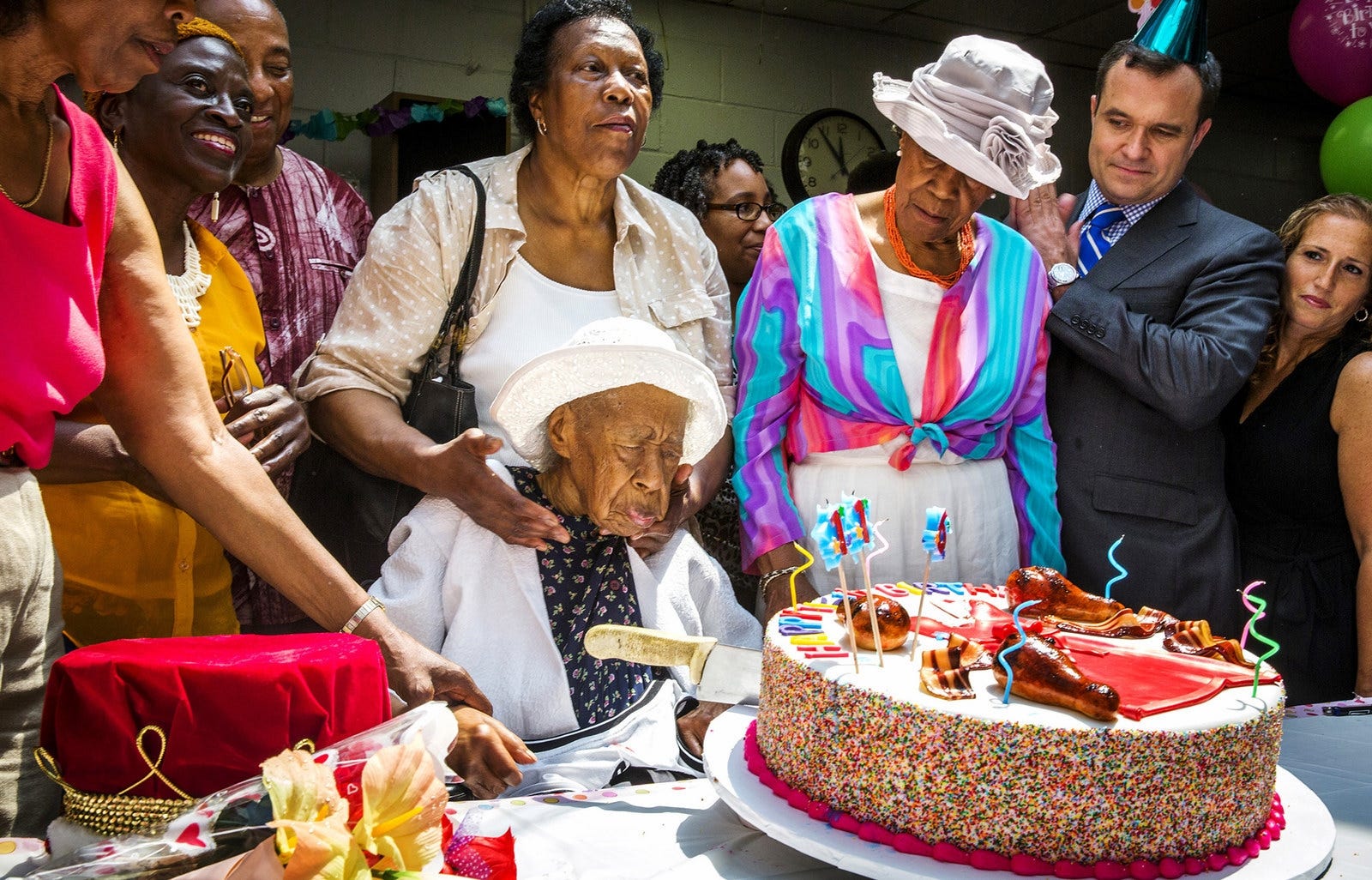
Many documentarians, especially those prone to first-person narration, reach a point where they make a film about mortality. Maybe it’s because they get to a certain age, or they receive an unfortunate diagnosis, or a parent or other loved one dies. Or they have children — which I know from experience can really alter your sense of time — and film them through the years. The pandemic also put death at the forefront of all our minds, but especially the minds of those recording reality daily. Sam Green checks all these boxes with his documentary The Oldest Person in the World, which he began a decade ago just after his father died and right as he was becoming a father himself for the first time. Then he found out he had a rare blood cancer. He had also just turned 50, which is technically past midlife based on the average lifespan, yet below middle age for those who make it past 100. Perhaps that’s one reason he made this film, which spotlights several women who live to 116, 117, or even 119.
Ever since my dad died four years ago, at 80, I’ve felt like that will also be the age of my endpoint, and I’m constantly thinking about how long I have until then. Never mind that his own father only reached the age of 69, and I’ve got a good chance of living longer because of my lifestyle and choices. I’ve also had a grandfather and great-grandmother on either side of my family tree live to be 97 and 99, respectively. Watching The Oldest Person in the World can give one hope of being like the Guinness World Record honorees who appear in the film. Especially female members of the audience, since all of the documentary’s titular participants are women. But the film can also be sad because it keeps introducing us to people who die shortly afterward. At one point, though, I laughed thinking about how they all die soon after being filmed by Green, making him seem like the cause, a curse, a grim reaper wielding a camera instead of a scythe.
Morbid humor arrives directly in The Oldest Person in the World as Green quotes a friend who said it’s “a film where the main character dies over and over and over again.” That bit of needed levity comes during one of the moments where the filmmaker discusses the suicide of his younger brother. During these sequences of mournful reflection, the documentary aligns tonally and structurally with Ross McElwee’s latest, Remake — he unfortunately only has one piece of footage of his brother, however; still, seeing Green’s son grow up over the decade of production on The Oldest Person in the World adds to the textual and aesthetic comparison. Very rarely do I consider another first-person-narrating documentarian in a class with McElwee, but Green gets very close this time, particularly with comments about people becoming “frozen in time” after death. He says of his brother, in voiceover while showing a specific still photograph, “The world keeps changing, but he stays the same, always talking on a landline.”
I do take issue with the idea that the film’s “main character” dies over and over and over again, even if it’s a joke, unless the statement means multiple main characters replacing the previous one. Otherwise, the implication is that the women Green visits are all the same. In some respects, they are very similar, even though they are of various races and widely spread across the world. They’re mostly immobile, have poor memories and eyesight, and their attitudes about their age are fairly alike. What brought them such longevity is unverifiable, though they all seem to have been rather carefree and stress-free. What brings them joy down to the end is where they can be easily distinguished. One loves Coca-Cola. Another is a nun who loves her faith, even if she doesn’t understand why God lets her live so long while allowing children to die. Another stays away from men (that’s also her secret to a long life, which goes with the stress-free idea). Still, the film does treat them homogeneously as subjects or props.
Anyway, the real main character is Green, and as with McElwee, he’s proving himself to be a through-line in his later work (I wonder if, like McElwee, he disagrees that he’s the protagonist of his films). He appears in them. He narrates them, often in person, as with his “live documentaries.” He connects some of them, as with how The Oldest Person in the World is kind of a spinoff of his Guinness World Records-focused 2014 project, The Measure of All Things. He also continues to be a substantial, innovative brand of filmmaker who has been expanding the scope of what documentaries can be, first with his live films and now with the notion, if not promise, that this one will be a living film. That is a perpetually unfinished one. This isn’t a novel concept, whether we compare his idea of revisiting The Oldest Person in the World every 10 years with the latest record-holders to the Up series structure, or his plan to rework and add to the film being akin to constantly revised, ever-evolving works like Loose Change. It’s an ambitious plan, maybe to be passed on to his son, and could be quite poignant if it goes another 109 years so that eventually it encounters a person who was born when the project began. But the idea could also get old long before it reaches that point.


