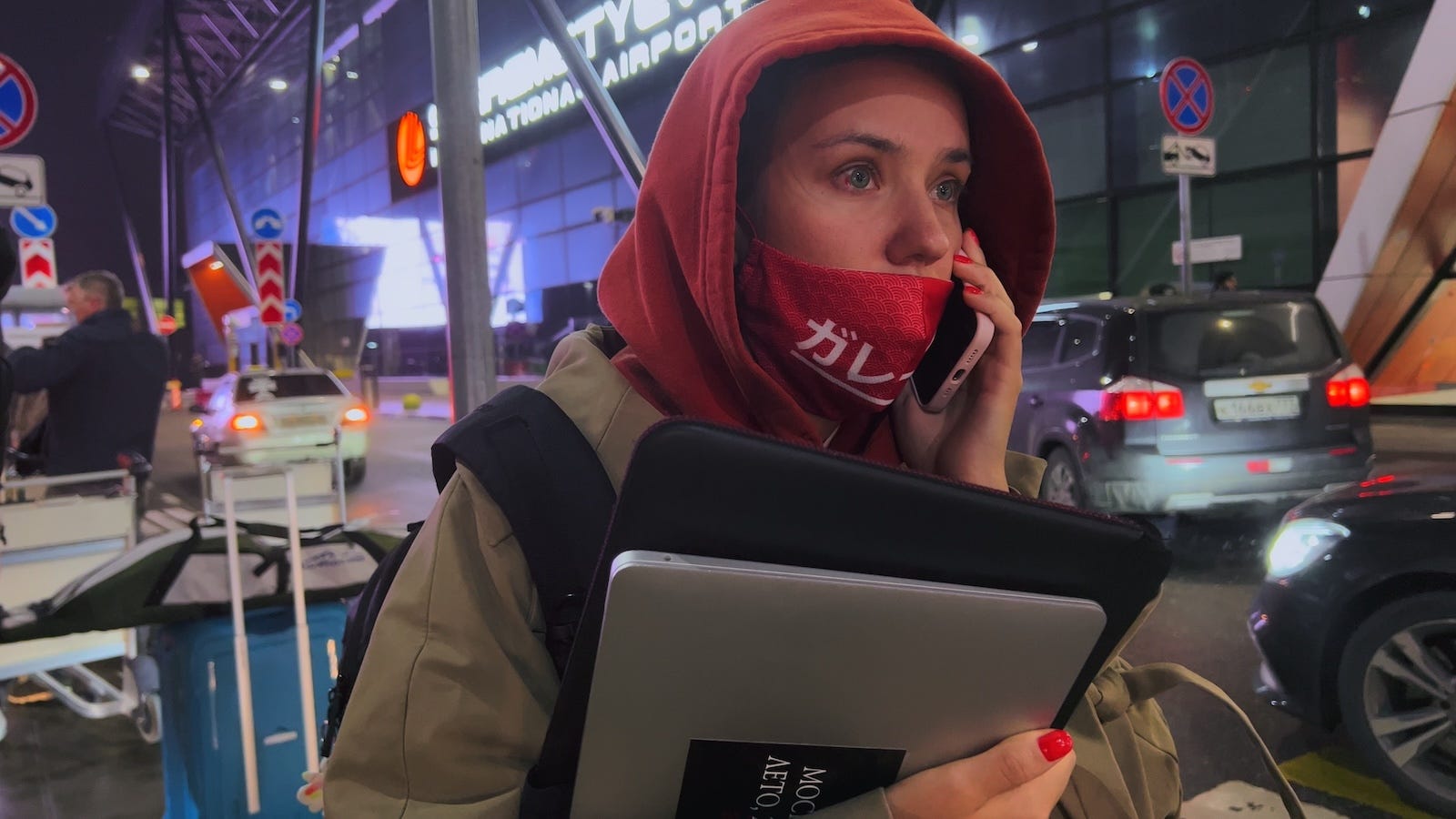
Julia Loktev On The Making Of 'My Undesirable Friends: Part I - Last Air In Moscow' & What To Expect With 'Part II - Exile'
A year and a half since the premiere of her acclaimed epic documentary, we talk to the filmmaker as it makes its streaming debut.
It was only a matter of time before I’d cross paths with Julia Loktev. I’ve been a fan of her lengthy film My Undesirable Friends: Part I - Last Air in Moscow for a while, even naming it one of the best documentaries of 2025. And we were in the same room at least once last fall when the film was nominated for Best Political Documentary at the 10th annual Critics Choice Documentary Awards. Still, we didn’t officially make each other’s acquaintance — albeit it virtually — until she did press for this week’s streaming debut of My Undesirable Friends, which is now available on Mubi.
By this point, it’d been almost a year since I watched all five and a half hours of the documentary, but it’s not hard to remember completely. And I was still curious about how Loktev and her collaborators came to create such an epic yet intimate film experience. I also really wanted to get some details on its upcoming sequel, My Undesirable Friends: Part II - Exile. We connected via Zoom this past Thursday for only 15 minutes, getting through only a smidgen of my questions. The good thing is I’m sure it won’t be the ast time we chat, and the next instance won’t take so long.
Below is our conversation in full, with light editing for clarity.
What was the original idea for the documentary? You obviously couldn’t anticipate where things would lead when you flew out to Russia to begin filming.
There was almost no time between conception and execution. Actually, the only thing that created time between them was that Russia wasn’t giving visas after COVID. So, there were a few weeks when I was waiting for one of the, I think, first tourist visas. I read a story in the New York Times in late Summer 2021, and the headline was something like “Russian Journalists Meet a Crackdown With Dark Humor.” It had a picture of these two young women, who looked like I could run into them in Bushwick, except they’d been named “foreign agents.” And I thought this was quite interesting. The humor was also like catnip to me.
What happened was that Russia started naming media and individual journalists “foreign agents” at this time. It started happening really quickly. Every Friday night, there would be a new list of “foreign agents” announced, which people would be checking over dinner. I thought I was going to make a film called “The Lives of ‘Foreign Agents,’” about these young journalists whom their government had declared “foreign agents.” It meant they had to put this really long paragraph description at the top of every story, in all caps, which said, “The following information has been created and/or distributed by a source of mass media foreign agent, blah blah blah.”
This would go on all your articles, on your videos, on your podcast, on your cat pictures on Instagram, in your parents’ chat. Everywhere you appeared in public, you had to first announce yourself as a “foreign agent.” And if you didn’t, it would be a fine the first time, second time is a fine, third strike is jail. Also, if you were interviewed somewhere. Let’s say TV Rain, which was Russia’s last remaining independent TV channel, had a guest, and they were a “foreign agent,” they had to say, “Well this is Christpher, who we must say is a foreign agent,” and if they didn’t they would also get a fine. It was this mechanism of control. It was new and incredibly disturbing, incredibly alarming, and I thought this was what the film was going to be about, facing this new level of crackdown on not only the media but also on simple society.
What we didn’t know at the time was that this was all a lead-up to Russia starting a full-scale war four and a half months later. And four and a half months later, all of our main characters fled the country, [along with] hundreds of thousands of other Russians opposed to the war, and their lives were about to change. Four and a half months later, it would not be possible anymore to be working as an independent journalist and speaking out against Putin physically in Russia.
I got incredibly lucky, I think, as a filmmaker. It feels wrong to say it, but it’s true. It’s like Joan Didion's famous line, “It was gold.” I got to capture history live, and characters we come to really get to know as people.
I say that a lot too, that while also sad, it’s beneficial to documentary filmmakers when terrible things happen.
That’s what we’re there for, to tell a story that hopefully is important to be told.
You knew some of these women, right?
I knew Anna Nemzer, who is a co-director on the film. I knew her socially since like 2018, I think. We’d known each other for a few years. And she had a show that she just started on TV Rain. She had another political analyst show, but she started this brand new show that I adored called Who’s Got the Power? where she would interview activists and people who were trying to create a different Russia. This was her act of protest, and she’s just brilliant and amazing. So I talked to her about making the film, and we embarked on this crazy project together, and she knew everyone else. Or there was one degree of separation.
I think it made a huge difference, first, the fact that I’m from Russia originally. I left as a child, but Russian is the language that I speak to my own mom. So, I speak native Russian, and people feel at home with me. But also that I came with Anna, who was incredibly trusted and respected. She said, “Okay, here’s my friend Julia.” And so it helped people open up because I wasn’t coming in as an outsider. I came in and was kind of introduced and guided.
That’s one of my favorite things about the film, that there’s this balance of the personally intimate and the more removed, observational perspectives.
It’s not entirely observational. I don’t pretend I’m not there, but I don’t talk very much. People talk to me, which is the camera. It hopefully puts the viewer in a position where you become that person on the other side of the camera, like where you’re the perspective you’re viewing it from. I’ve had people say that, to them, it feels like these women become their undesirable friends too.
And they’re very, very desirable friends, I promise.
“You can read Wikipedia or a New York Times article, but what this gives you is a chance to live through it with people who, in a way, we usually only get in a fiction film.”
When did you realize the kind of film you were making, not just in terms of the content but also the structure, length, multi-part, etc.?
Everything changed the night that Russia started this historical war. Up until then, I thought it was going to be a slow burn of a film about people deciding how much repression they could take and trying to figure out how to keep working in this country. Is the time to leave tomorrow? Was the time to leave yesterday? How do we work under this increasingly oppressive regime? Then, Russia started a criminal full-scale war in Ukraine. Hundreds of thousands of people fled, and I realized I was there capturing this historic moment because I was in Moscow the first week of the full-scale war, as the U.S. embassy was telling all Americans to leave. I said, "Okay, I think I’ll stay,” and I stayed until every one of my characters left the country.
At that point, I realized I’m capturing something that is absolutely historic. And I had the incredible advantage. It’s not that I flew over and started filming then. It would be a different film. I was capturing through people whom we’d known for four months already. We’d already lived through it. You knew them intimately. You knew them as characters the way you do in a fiction film. Suddenly, they’re having to flee their country with a carry-on suitcase in a few hours, and you’re living through this with them. And I think it’s really rare that you get to experience that, that you’re in a position as a filmmaker to capture something at this moment, capturing it live.
Actually, I kept filming them. I didn’t go home. I kept going from country to country to country filming them because there’s a Part II - Exile coming. Which also is like, if you think of all the different populations that have had to flee into exile, whether it’s the Iranians after the Revolution, Russians after the 1917 Revolution, it’s something that has happened to different populations. Where suddenly there is this mass exodus of people who find themselves no longer able to live in the country and not be arrested. Suddenly they’re spit out into the world. They have no idea what country they’re going to next. They have no idea what the future holds. All their professional lives have fallen apart. Their entire lives have collapsed.
I got to capture all of this live, and at that point I said, “Wow, I’m just gonna honor the footage. I’m going to make the film that it needs to be.” When people hear it’s five and a half hours, they think maybe it’s going to be slow, and it’s anything but slow. It’s five and a half hours of exhaustingly fast…It’s really dense. It’s fast, but it’s also a lot of details of life, which I think is what interests me. It’s not information you can get anywhere. You can read Wikipedia or a New York Times article, but what this gives you is a chance to live through it with people who, in a way, we usually only get in a fiction film. Made after the fact when you try to imagine what it was like to be there at this moment. Usually it takes fiction for that.
“For this whole project, I’ve tried to just honor the footage.”
I think it seems to play faster the more you get to know them, too. Why did you decide to tell us the fates of these women long before you show those events?
Somebody asked me that the other day, and I didn’t really have a good answer. I was thinking about it: First of all, you’re going into this film knowing what happened. You know Russia starts a full-scale war. And I assume you know a lot of Russians fled, who were opposed to the war. But of course, you’re watching characters who have absolutely no idea for the first three hours that their country will invade Ukraine fully. (There’d been a war going on for eight years, but everyone had gotten used to it. The kind of war that’s now going on was unimaginable.) You’re watching these characters knowing something they don’t know. I figured to just lean into that.
There’s a different way that you watch something because it starts with the line “The world you’re about to see no longer exists.” You watch something very differently, just knowing that you are watching something that then becomes extinct. Because literally the entire ecosystem, the entire world the film shows, doesn’t exist anymore. It’s unimaginable, actually, now from where we are, that it did exist just a few months before the war. Because we’re thrown into this Moscow where there’s a television station that looks like MTV back in the day, where there are protest bands singing, “I’m the fifth column. I’m a national traitor. My Russia exists autonomously from yours. You throw people in jail and start wars. We have people too, and we’re stronger.”
That is absolutely un-effing-imaginable now. Any of these people would be thrown in jail immediately for doing what you see them doing. You’re watching this world on the verge of extinction, and I thought it was important to know that. Although somebody said it’s like film noir. Like you start out with a body in the pool, and you have to figure out how it got there.
Given the tremendous success of Part I, have you felt any pressure while working on Part II to make it just as good or just as important?
For this whole project, I’ve tried to just honor the footage. For Part I, I had somebody come in and say, “Great, we’ll give you all the full budget” — which I still haven’t fuly raised the full budget — but it would have meant committing to a 90 or 120 minute film. And I said, "No, thank you, I’m going to honor the footage.” I just have to spend time with the footage and make the film that I have to make. Luckily, it’s been very well received. So, I try not to worry about those things.
But it’s very different because Part I, you know, it all takes place in Moscow, as the title says, and it ends with everyone fleeing Moscow. Part II picks up literally like two days later in Instanbul, where a lot of people flew because it was one of the few places you could buy a plane ticket to. There aren’t planes flying to Europe, to the U.S., to Australia. There were only a few countries. There are still only a few countries that planes will fly to from Russia. They were flying before the war, obviously, but commercial airline traffic stopped. So they bought whatever tickets they could. They went to Istanbul, and one of the characters says this great thing, “Yesterday, I had a life. I was an anchor at TV Rain. I had a boyfriend and an apartment. And now I’m a loser in Istanbul.” Their entire lives have fallen apart.
Meanwhile, their country is waging this criminal war, and they all feel this imperative to get back up on their feet as soon as possible, even as they don’t have a place to live, and keep working as journalists. It follows them over the next years as they continue to work despite being threatened, facing incredible risks, many of them have criminal charges against them in Russia, some have been sentenced in Russia, they have been physically threatened. But they all continue to report on Russia for Russians, hoping to offer Russians an alternative to propaganda.
It’s this larger subject of exile. It’s not losing a home. It’s about decency. How do you take accountability when your country is waging a war that you oppose? None of them washes their hands of it. That’s all really important to me. They also talk about Russian war crimes in Ukraine, but they also don’t say, “This is not my problem.” They all feel complicit, and they feel responsible that they have to do something.
It still has humor, though, despite all those serious subjects. We still got jokes.


