

One year after the Oscars introduced its first official “documentary” category, Best Documentary (Short Subject), that award disappeared. In its place, a more broadly encompassing category, Best Documentary, appeared and also lasted only one year. Today, that category is considered the first instance of the Academy Award for Best Documentary Feature, but that shouldn’t be the case. Of the whopping 25 nominees1 for Best Documentary at the 15th Academy Awards held in 1943, only two would qualify as “features” by the organization’s rules despite both still being under an hour. The other 23 are all shorter than 30 minutes. Of those, 17 are shorter than 20 minutes, and four have a runtime of less than 10 minutes.
With so many nominees, it’s no wonder that four of the films tied for the Oscar for Best Documentary: The Battle of Midway, Kokoda Front Line!, Moscow Strikes Back, and Why We Fight: Prelude to War. It’s also for the benefit of Academy Awards history that half of these winners were the two medium-length documentaries that would qualify as features by the official Oscar rules. Moscow Strikes Back was originally a true feature, running anywhere from 66 to 110 minutes in its various forms released in the Soviet Union. When it was reworked for American audiences, with English-language narration by actor Edward G. Robinson, the documentary was only 55 minutes long. That would be the version that the Academy recognized.
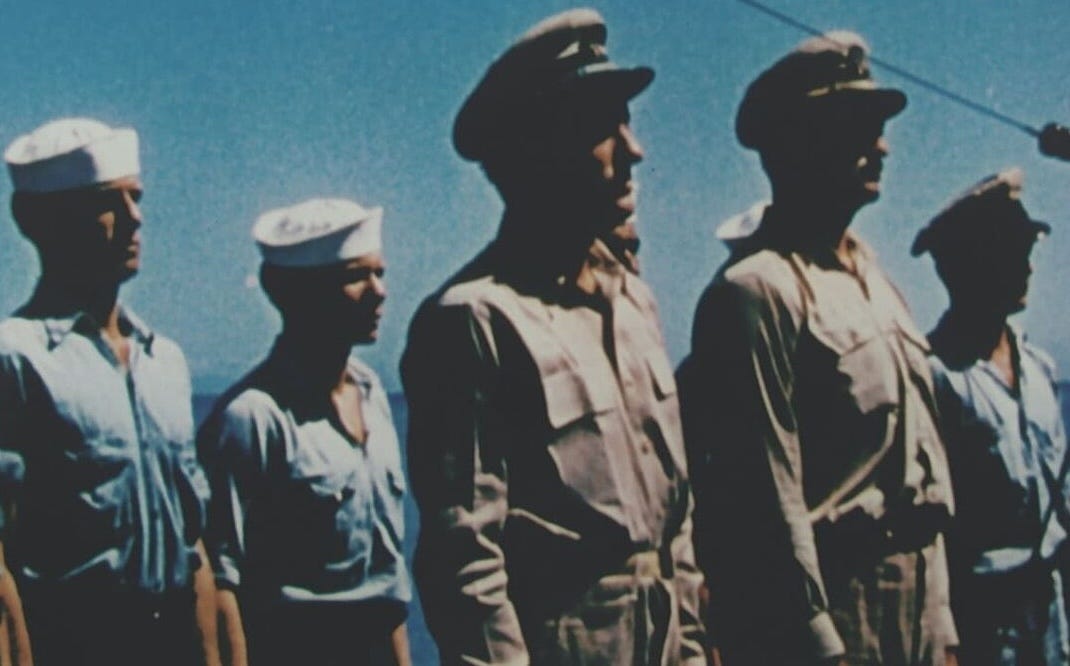
All four winners are also World War II propaganda films. Nearly all of the 25 nominees were either directly about the war or had some relevance. The two about agriculture, one about income tax (starring Donald Duck), and another about people with loose lips sinking ships tied back to the war effort in some way. Only one of the nominees, a nature film about bird migrations titled High Over the Borders, had nothing to do with World War II. Among the winners, I’ve previously declared The Battle of Midway is the best American propaganda film of all time. I wrote that the John Ford-helmed Technicolor short “makes the viewer feel the fight, to see what it’s like to be a soldier who may not even himself know or comprehend the specifics of each mission, and the sensation can be much more inspiring than something more informative.”
