

Once the Oscars began awarding two documentary-specific categories, the honored features and shorts could represent contrasting approaches to nonfiction cinema. There’s a big difference between telling a true story in a film lasting more than an hour versus doing so in less than 40 minutes (sometimes, as in the case of the 1944 winner December 7th, the disparity between a feature and short version of the same film is night and day). With a few years in the history of documentaries at the Oscars, the feature and short winners corresponded fairly well: in 1946, the two films dealt with the World War II victory over the Nazis; in 1983, both involved ballet schools; the two 1995 films focused on the Holocaust. In 1945, however, the duo of documentary Oscar winners, the feature-length The Fighting Lady and the short With the Marines at Tarawa, were a particularly perfect pair for their similarities and differences.
The two films depict parts of the Pacific Theater of World War II in full color, with the feature covering multiple battles over a year in the life of an aircraft carrier. The short offers a look at one battle not shown in The Fighting Lady — even though that film’s carrier, the USS Yorktown (CV-10), was involved — which took place within that time frame. If you wanted to watch the pair together and preferred to do so chronologically, you’d have to pause The Fighting Lady around the 26-minute mark, put on With the Marines at Tarawa for its entire 18-minute runtime, and then continue the remaining 36 minutes of the feature. I wouldn’t recommend that. The films go together much better sequentially. I prefer the way I watched them: The Fighting Lady before With the Marines at Tarawa, even though the latter was released 10 months earlier and could be considered on par with receiving bad news first.
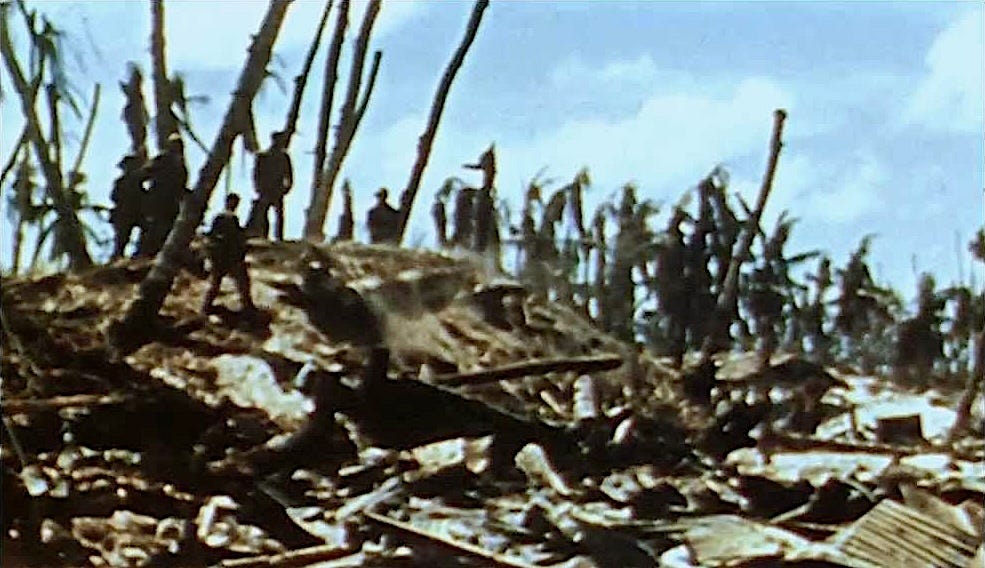
The short film was famously graphic in its portrayal of the Battle of Tarawa, which the U.S. won but at a tremendous cost in terms of American lives lost. Later victories in the Pacific saw more casualties, but this one was more surprising in its toll and, in some respects, was deemed a failure the Allies had to quickly learn from if they were going to succeed in the long run. The documentary doesn’t shy away from the facts, from its opening statement that some of the men we see on screen “will be dead tomorrow” to its climactic montage of floating bodies, additional fallen men dotting the island, and confirmation that “these are Marines dead.” Earlier, the film’s narration (voiced by actor William Lundigan) acknowledges that the casualties at Tarawa are high, which notably contrasts with a line from The Fighting Lady (narrated by actor Robert Taylor) proudly asserting after one battle, “Our losses are astonishingly light.”
