

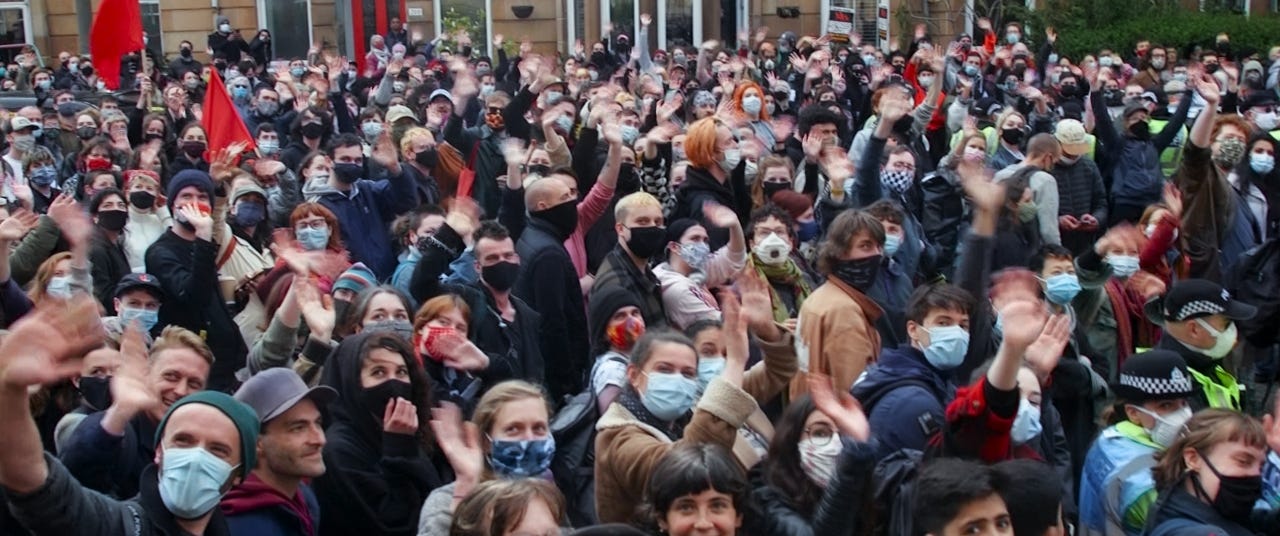
Everybody to Kenmure Street is the documentary we all need right now, for its inspirational showcase of solidarity and effective peaceful protest, as well as for its refreshingly creative choices that blend crowdsourced footage, aesthetically conscious interviews, historical context, and staged elements featuring familiar actors. The award-winning film is primarily about an impromptu demonstration of community action responding to a deportation raid in Glasgow in May 2021. Thousands of locals surrounded a van holding two of their neighbors, blocking its departure. One man even stationed himself underneath the van to keep it from moving at all. Spoiler alert: the protest was successful, resulting in the release of the two men.
The film is concentrated on that singular event in that singular location, but it’s also about anywhere in the world that could use some hope and harmony. It’s a reminder that protests work and, more importantly, communities can make an impact when they come together, not allowing those in power to divide them. It’s a reminder of the allies who are there with you in the present and throughout the past as you challenge morally corrupt authorities. Everybody to Kenmure Street is a call for everyone to watch and experience the Kenmure Street protest as if seeing it or being part of it as it unfolds. I recommend doing so in the theater for an optimally intimate and collective appreciation of the story and the artistry involved in its telling.
Felipe Bustos Sierra is the central artist behind Everybody to Kenmure Street. The filmmaker is himself an immigrant residing in Scotland, having been born and raised in Belgium, and is the son of an exiled Chilean immigrant. His first feature, Nae Pasaran, was about Scottish factory workers who went on strike in solidarity with Chileans during the Pinochet dictatorship. Everybody to Kenmure Street is his second feature and continues some of the same themes. This week, I spoke to Bustos Sierra about the new documentary, the impact it’s had on him and its various audiences, and some of the fresh ideas behind its production. Below is our conversation, mostly in full, edited for clarity.
I read that before the day that you document in the film, you had given up on protests. Did you immediately change your mind after the event, or while making the film, or since making the film?
I’d lost faith in mass protest. Bodies on the street. It didn’t feel like it was having the impact it used to have anymore. Part of it was the research for my previous film, Nae Pasaran, and talking to civil servants in the UK government's Home Office and Foreign Office. One of the comments that stayed with me was at the Foreign Office. In London, a million people walked past their window during the protest of the War in Iraq, back in the day. Their reaction was that somebody just basically shut the only window that was open to cover the noise they were making. It didn’t seem to have any sort of register in their consciousness. There’s that quote from Kwame Ture that peaceful protest only works if your position registers some kind of consciousness.
There is something different about Kenmure Street. They’re not just protesting in the street. They’re physically blocking the streets, so they became a force to be reckoned with. But [my loss of faith had] stopped me from going. I just assumed if there was any sort of resistance, it’d be cleared very quickly and very violently. That’d been the case for this sort of peaceful, silent vigil in the run-up to Kenmure Street. Or, that by the time enough people turned up to make a difference, the van would have gone. I guess that was the information I had first thing in the morning. Then, watching it unfold on social media, I realized something different was happening.
At first, my thinking was not to make a documentary about this. My first instinct was how did I miss out on this physically. I didn’t express my solidarity. I didn’t get to feel what people felt that day as a massive expression of collective joy. They all got to feel something they created themselves. I will never feel that. That’s something I’ve never gotten to feel in my life. Few people get to feel that in their lives. Part of making the film was working out: what did I miss that I hadn’t seen before? And do we need to change our perspective on how we look at protests? But also, is there maybe a way to emotionally connect to what happened that day through making a film about it? That first week of doing research and talking to people who lived in my neighborhood, I was very charged up, and by the end, I was like, there was a different way to talk about protests in our day and age.
