

The powerful and multifaceted documentary Enemies of the People, for which its co-directors received Human Rights Watch's Nestor Almendros Award for courage in filmmaking, has its roots in the long, confessional Holocaust film Shoah (especially the interviews with the ex-Nazis) and the recent personal investigative films from Argentina, such as Our Disappeared and Los Rubios. On one level, it is a strictly historical project being conducted by Thet Sambath, whose father, mother, and brother were all victims of the Killing Fields massacres during Pol Pot's regime in Cambodia during the 1970s. On another level, it is also a moving film by Rob Lemkin about this project, which Sambath has been working on for the 10 years leading up to the U.N.'s war crimes tribunal.
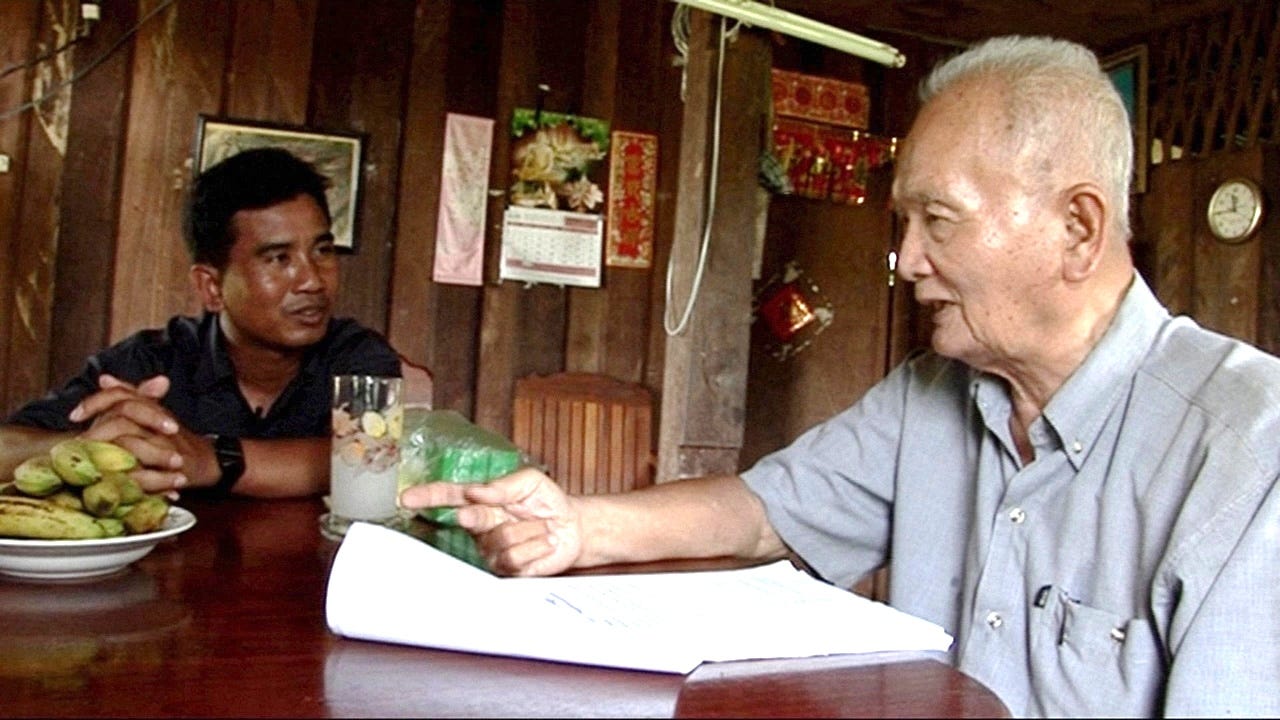
At the center of the project is Sambath's lengthy interviews with the Khmer Rouge second-in-command (aka "Brother Number Two"), Nuon Chea, who has no idea of his interrogator's family history. These sequences remind me of the interviews with Robert McNamara for The Fog of War, yet they have that personal connection that allows for a greater emotional response. It's unsettling because Sambath is incredibly easygoing and even forgiving during his encounters with Chea, who is admittedly apologetic to a degree, but who also watches the hanging of Saddam Hussein on television, commenting that the Iraqi dictator was a patriot and a "winner, not a loser."
Other sequences show us Lemkin and Sambath's travels to the infamous fields, where Sambath talks casually with men and women who were perpetrators or complacently involved in the killings. In one disturbing scene, Sambath and one of the admitted murderers laugh together as the former asks the latter to pretend to kill him, for historical purposes. And then the old man does illustrate, rather closely, how he would slit or stab the throats of his victims. It's one of those important yet very difficult viewing experiences, as significant as the 30-year-old archive footage that Lemkin presents to us at the film's end, of piles and piles of bodies and skeletons.
Enemies of the People can get repetitive at times, as Sambath repeats some stories and information about his project here and there, but it is altogether as much a necessity as the comparable Human Rights Watch doc War Don Don and any other historical documentary about the Holocaust or other mass slaughter. If you can take it, see it, and just try to imagine yourself in Sambath's shoes as he sits there next to or opposite the men responsible for the deaths of his parents and millions of others.
A version of this review of Enemies of the People was originally published in a Human Rights Watch Film Festival roundup for the now-defunct movie blog Cinematical on June 16, 2010.