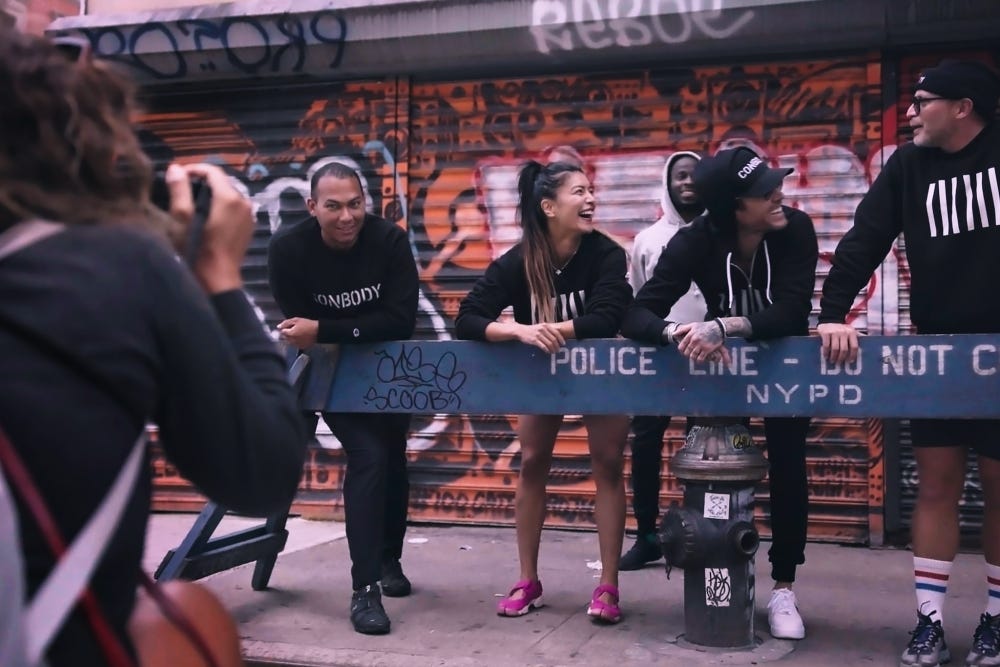
Debra Granik is best known for directing Jennifer Lawrence to her first Oscar nomination in Winter’s Bone, a drama that also earned the filmmaker recognition as a screenwriter. In addition to writing and directing two other acclaimed fiction features, Down to the Bone and Leave No Trace, she helmed one of the best documentaries of 2015, Stray Dog. Now she’s back to nonfiction with Conbody vs. Everybody, a five-part film she worked on for about a decade. The documentary follows a formerly incarcerated man who starts a fitness gym based on the exercise regimen he developed behind bars. This business also only employs other former inmates.
Almost 12 years since Granik gave then-fledgling Nonfics a shoutout in the New York Times, I finally made her acquaintance. We got on a Zoom call to talk about Conbody vs. Everybody ahead of its streaming debut on The Criterion Channel on May 1, 2026. We discussed the fiction script that led to the documentary, her initial expectations for the project, and why she finally had to stop filming her subjects. She also broadened my perspective on what the true crime genre should focus on, while confirming what we all know are the mainstream media’s definitions and interests. Below is our conversation, edited for clarity.
When Nonfics last interviewed you in 2015, you mentioned that you were working on a documentary about reentry after incarceration. But I understand the initial idea was different from what the project became. How and when did you meet Coss Marte and then decide to make the film about him and his entrepreneurial efforts?
We were thinking about a project that was a fiction narrative, about the revolving door of the carceral system of the U.S. In 2014, the concept of mass incarceration was finally getting a lot of attention. For me, the suspense and intensity of stories about returning from prison was to be found in the firsthand experiences rather than fiction. The story was going to be a person actually coming home, performing this intense process that we call reentry, which is reintegration into civilian society from your pariah status as a person behind bars.
So we needed to find someone who was interested in trying to explore that—to show how he’s going to live it. And Coss went beyond that. He wanted to involve other justice-involved folks and also non-justice-involved people, realizing that we won’t make much headway if people who haven’t been in the criminal justice system don’t care at all. Coss was looking for ways for non-justice-impacted people to want to understand this other part of American life. I’m fresh out of prison, and I have to get to my new job, but I don’t have money in my pocket. Am I going to jump this turnstile? Am I going to risk getting re-ensnared in the criminal justice system in order to get to work on time?
This is how he pitched it back to me. There was a really positive meeting of the minds between Coss and our filmmaking team.
And then Coss built the Conbody crew pretty quickly. He wasn’t doing this alone. This is where nonfiction gets so scintillating. He’s creating this scrappy urban novel in front of my eyes. He’s saying, “I’m not going to go through reentry by myself. I’m going to build a family around me. This is how we survived on the streets, and inside, and this is how we’re going to do this part of our life.” He proceeds to do that. The odds are against him.
For this project, we got presented with New York in its cinematic bounty — life on the streets, its architecture, its infrastructure, its vicissitudes. It was like the scene cards were being dealt to me really quickly. Here’s a set of compelling individuals, New Yorkers who are going to do their damnedest to survive. Here’s a neighborhood that’s textured as heck to photograph. And here is an American set of themes that you can’t walk away from. What are you going to do? Film for a lot of years, I guess.
From what I read of the fiction project, the film’s ending would have been tragic, with the main character back in prison. I’m glad that with the documentary, we instead get a positive story of people succeeding after reentry, defying not just the odds but the stereotypes. Was this something you were consciously rooting for?
Absolutely. I’m drawn like a magnet to people who defy stereotypes and expectations. We, as a society, Americans, prefer a categorical “or.” This is just a hallmark of our culture. We prefer clarity or black-and-whiteness. Or binariness instead of “and.” The exact definition of defying the stereotype is “and.” Someone is very intrepid, and they care a whole heck of a lot about this aspect of their neighborhood, this aspect of their family, this aspect of sharing profound emotions with other men, whether they’re inside the prison system or outside.
These individuals are problematic because they are complex and therefore difficult to portray. It’s easier to portray black and white, “or.” “Stray Dog” did the same thing to me. I had a very parallel and intense response to encountering someone like Ron Hall. There was north/south. There was red/blue. There were several encampments that he and I stood in that were not opposing but quite separate. For two people to walk from their camps and commonality is messy, but it’s worth it.
The same goes for social class. The number of times you step out of your social class is limited. Your class background, your class socialization, what people normally do within the confines of your class, the education you’ve received, the types of work you try to do in your life, when you meet people who have come up differently or been dealt a very different hand, there are a lot of reasons to have a very intense conversation over many years.
I think documentary filmmakers are often built with a tic in their brain, and the tic is often a set of questions about experiences outside their own. How have you navigated? What do you need the most in this life? How are you going to get it?
We’re born into a very limited path, and there are times you wake up and recognize: You are empirically my neighbor. I live 11 blocks from you. The only way I’m ever going to get to know you is if we have this conversation. Otherwise, we will remain in separate spheres. Even though it is less than one mile as the crow flies from where you dwell and where I dwell.
That reminds me of the scene late in the film when Coss’s brother talks about bringing the neighborhoods together as one community.
Christopher is magnificent at trying to bring that idea up to a whole variety of people across a lot of lines. Not just linguistic and ethnic, but a lot of lines. I appreciate that you saw that in the film.