'American Doctor' Review
Poh Si Teng's feature directorial debut follows three American physicians who've been lending their services in a Gaza hospital.
The opening scene of American Doctor involves a debate between the filmmaker (Poh Si Teng) and one of the documentary’s participants (Dr. Mark Perlmutter) over whether or not to show uncensored images of dead children. It’s the most interesting part of the film and reminded me of so many documentaries in the past that have featured children’s bodies being dug out of rubble, dead babies in hospital rooms, and small caskets being made for the youngest civilian casualties of war. These images are indeed important to show, and are very powerful, but they also seem to be exploited. In documentaries, they’re film props, even if they’re necessary and effective as such. Showing pictures of a murdered child famously sparked the American civil rights movement. Perhaps images of bloodied infants can end a genocide too?
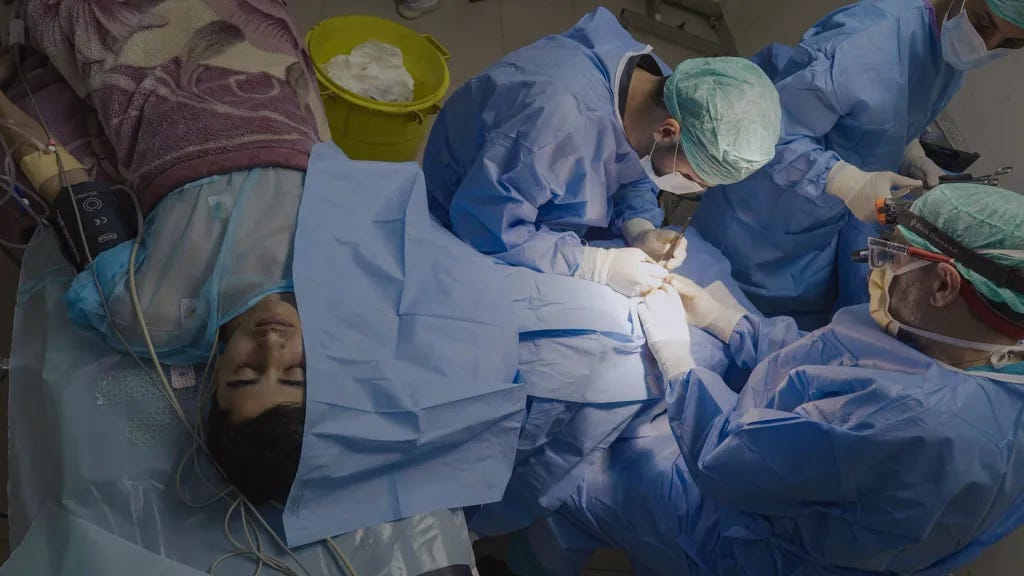
American Doctor is an Oscar-contending documentary about three individuals who fit the film’s title and have traveled to Gaza to offer medical assistance during the current war between Israel and Palestine. Two of the doctors, one of them Jewish, the other the son of Pakistan-born Zoroastrians, are filmed on their latest trip. The third, who is of Palestinian descent, remains in the U.S. after being denied another visit. The documentary’s premise sounds like the setup of a joke involving three men of different religions entering a bar, but is certainly not treated that way. It also sounds as forced as including obligatory footage of dead children. It’s actually more of a coincidence (though the film or its marketing acting as though the Pakistani-American trauma surgeon is himself a true Zoroastrian is a stretch to fit the conceit). And ultimately, it hardly matters what faith or religious ancestry might define these physicians. The point is more that they’re Americans politically and morally opposed to the war and especially to the bombing of hospitals.
Perlmutter and his featured colleagues, Dr. Feroze Sidhwa and Dr. Thaer Ahmad, are heroes for helping to save lives despite the risks of them being the next incidental victims of targeted airstrikes. But this film isn’t about championing their bravery or portraying them in action, à la the subjects of such documentaries as Feras Fayyad’s Last Men in Aleppo and The Cave, the latter of which also involves hospital workers in danger of being bombed. American Doctor is a lot more discussion-driven. These men also make appearances on cable news programs to give witness accounts of what they’ve seen in Gaza. There is a revelatory moment that’s key to the focus of the documentary when one of the film’s stars is hearing a local doctor tell of the death of their child, and Teng keeps the camera on the American the whole time as his eyes well up with tears. I can imagine her wanting to turn the lens toward the audience next, as it’s all about getting a reaction. I can’t deny its effectiveness in doing so.


