'The AI Doc: Or How I Became an Apocaloptimist' Review
Daniel Roher attempts to ease his existential fears about artificial intelligence by constructing the issue documentary to end all issue documentaries.
When someone in The AI Doc: Or How I Became an Apocaloptimist says that any examples put in the film are going to seem clumsy by the time it’s released, they’re not kidding. Artificial intelligence is moving so fast that the documentary could’ve easily been dated by the time it premiered at Sundance, let alone three months later. Fortunately, this isn’t really a film about AI. Sure, that’s the subject being discussed, but it’s all just filling. This is actually a documentary about any concerning issue if you read between the lines. It’s an example of how all issue documentaries should play out, but it’s also the issue documentary that drops the mic on all the world’s problems.
Daniel Roher, the Oscar-winning director of Navalny, makes himself the protagonist of this film (co-directed by Charlie Tyrell), as he interviews experts on artificial intelligence in an effort to quell his existential dread about the technology. First, he talks to the people spreading doom. They discuss all the fears about AI, from the jobs it’s making obsolete to the complete and abrupt extinction of mankind. Roher goes from mere cynicism to terror when he and his wife become pregnant with their first child, and he wonders if having children right now is a bad idea. One of the interviewees bluntly predicts that the kids born today won’t even make it to high school before we go the way of the dinosaurs.
Then Roher talks to the people who see the good in AI, how it’s helping to cure disease and solve all the rest of the world’s problems. Sure, computers will take our jobs, but that means we’ll live in a labor-free utopia where we can all be painters and poets. Roher acknowledges his film has swung like a pendulum. Ultimately, he finds the balance, which mostly comes down to humans being the real concern in the AI race, but he also recognizes the uncertainty of its future. I’ve seen so many issue documentaries that only focus on the doom (the other Sundance AI doc, Ghost in the Machine, comes to mind), and I’ve seen so many that stop after swinging the pendulum to the other extreme. This one has the third act they all need, as anticlimactic as it might come across. In fact, its third act almost applies to all the rest.
The key is to understand and believe the still-hopeful message here, one that tends to come in the form of simple titles at the end of other documentaries: do your part. I don’t know if I trust humanity to be what this film wants of it, though. Most people will be fine with what Anthropic CEO Dario Amodei says in his interview, that we have no idea where things are going, so just do what you’re going to do anyway. Most people like the dazzling distractions of AI too much to give them a second thought, let alone to give the whole topic a deep consideration or to spring into action in response to its dangers. But just because I remain cynical at the end of this film doesn’t make it bad. Again, it’s Roher’s journey. And how it concludes is how Roher concludes the matter personally (with help from his wife, filmmaker Caroline Lindy).
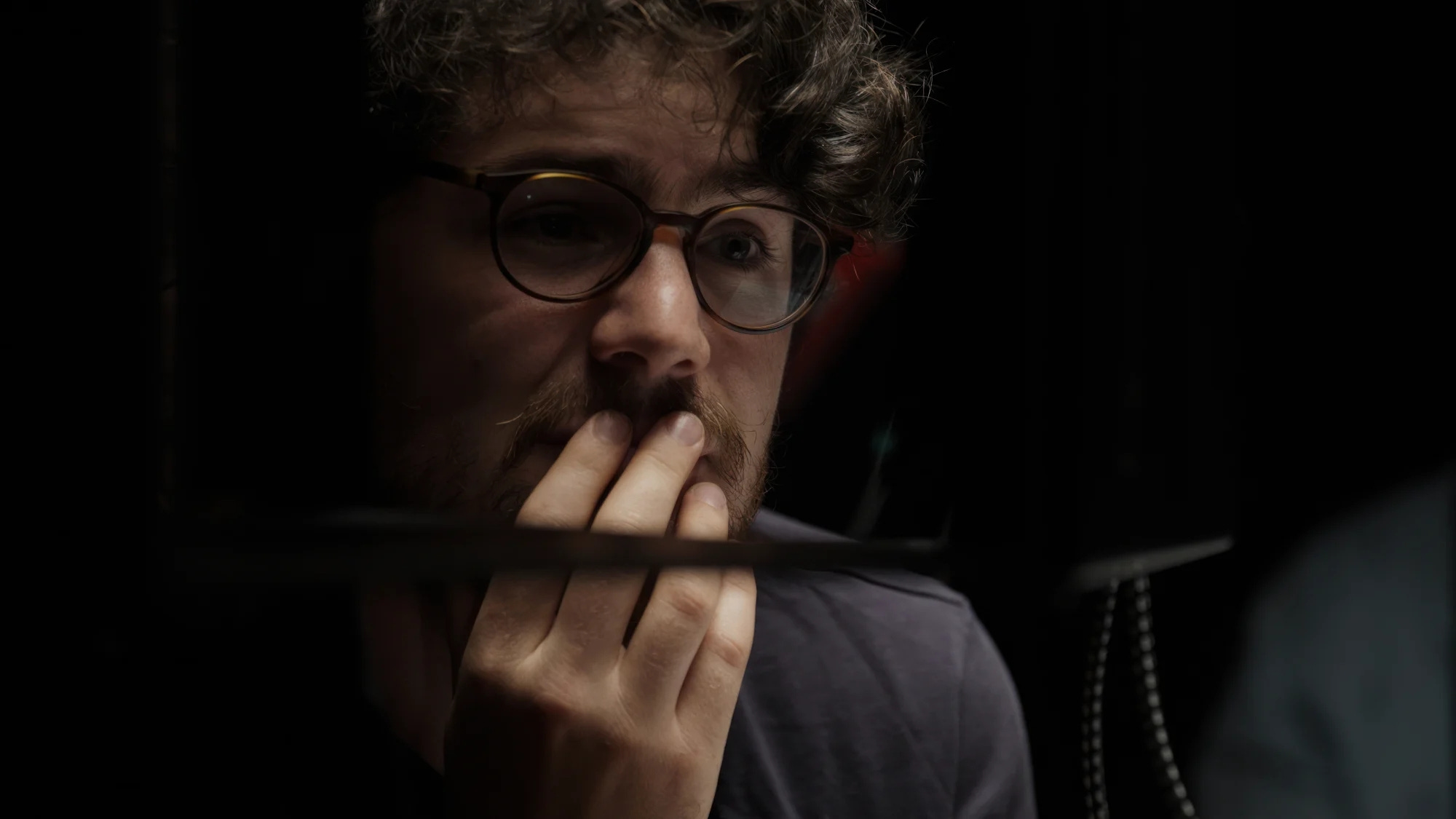
That Roher makes this such a personal film allows it to be so effective. Very few first-person issue films work as well, though, because they’re more self-centered and self-serving. The AI Doc: Or How I Became an Apocaloptimist is relatable, in part because of the parental anxiety and also because Roher asks such universally and inclusively concerning questions. He really seems to be doing the film for us as much as for himself. He’s also just relatable as a genuine, personable character on screen. The way he constantly cuts back to himself during interviews isn’t out of self-importance or to help out the editors (Daysha Broadway and Davis Coombe). It’s to make him identifiable in his expressive and sometimes profane reactions to what’s being said.
Roher and Tyrell also inject the film with an overdose of visual elements, maintaining an unnecessary but dynamic playfulness that keeps the viewer attentive. The variety of animations showcases Roher’s drawings (familiar to those who follow him on social media) and recalls Tyrell’s amusing 2018 short My Dead Dad’s Porno Tapes as well as some of the aesthetic of the similarly AI-focused family film The Mitchells vs. the Machines. You also wouldn’t be surprised after watching the documentary to learn that two of the creative geniuses behind Swiss Army Man and Everything Everywhere All at Once (Daniel Kwan and Jonathan Wang) were involved as producers.
Thankfully, those visual elements add to the personality of the film rather than being more dazzling distractions. What might not help with all audiences is the simplicity of the portrayal of the issue at hand. The AI Doc: Or How I Became an Apocaloptimist spends a long time explaining AI, but never goes that deep into its definition. There is little information or contemplation in the film that will educate or surprise anyone generally interested in the subject, and even its resolution may feel thin. That’s more suitable for the viewers who need to be pulled away from watching AI-generated nostalgia-baiting mashups and other bewitching slop, if only that were so simple.


